
 When I was about 11 or 12, my favorite hobby became Dungeons & Dragons—better known as D&D. My friend Kevin, who was visiting from Vancouver, introduced me to the game, and we played every day that summer. Kevin never liked school. He avoided reading and rarely studied, but D&D changed everything. Once he discovered the game, he started reading voraciously. After all, it’s a complex game with plenty of rules to master.
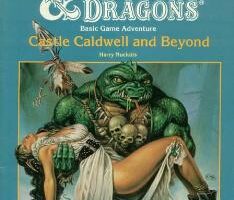
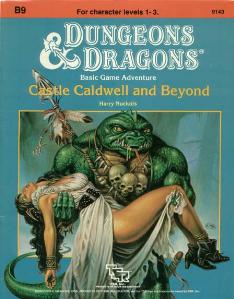
The first dungeon module I bought was Castle Caldwell and Beyond. The cover art was done by Clyde Caldwell. Which I think is a nice coincidence. Perhaps the reason for the name. Later, I used to play with my friends Curtis and Bonnie when I was a teenager. We would sped many hours rolling dice and making up characters. Poor Curtis was always the dungeon master.
What makes it interesting is it is basically interactive story-telling. You have one person who constructs the narrative, the dungeon master. This person is responsible for setting the scene and atmosphere. They control all the monsters and non-player characters (NPCs).
The other players in the game each control a character. Players use dice to determine the outcomes of different scenarios. For example, monsters may attack your party of characters. You might roll dice to determine if you hit one with a bow and arrow.
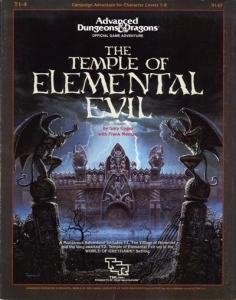
It fell out of favor as a hobby with the rise of the “Satanic Panic” in the 80’s, but like so many things, we’ve seen a surge of interest recently. Featured in the show “Stranger Things” D&D has become popular again. It has spun off numerous other fantasy games, books and movies. I found out that a friend here in Toronto still plays so for Christmas I gave him my “Temple of Elemental Evil” module. It’s about as old as the Castle Caldwell one.
 What makes D&D a great hobby it is engages a number of different parts of the brain. There is creative story telling. The modules provide a framework for the imaginary adventure but don’t fill in the tone or details. Most of that is done by the dungeon master. Players are expected to play their characters according to, well their character. For example, if your character is a barbarian they are expected to smash things, and fight with a battle axe or something. They will have high numbers in the strength stat, but lower scores in intelligence.
There is also some rudimentary math. Characters and monsters have hit points, stats and experience. All of which are based on a variety of factors. Players need to roll dice to determine outcomes and the DM (Dungeon Master) needs to keep track of all of this.
On top of all that there is strategy. You are playing as a team which means you can’t be casting fireball if the barbarian is in the way, you will only hurt your own players. It also has the benefit of being a social game. Which forces players to interact with each other and the DM. You can’t play the game by yourself.
I suspect that the game will continue to gain in popularity as new generations discover it. I also wouldn’t be surprised if it ends up being played in old folks homes to keep seniors minds sharp.