

As I stated at the beginning of these hobby posts, they are really about happiness. I am deeply interested in happiness, and what makes us happy. I dislike the saying “Money can’t buy happiness” because for most of us, our relationship with money is very complicated and multi-faceted. Money could by happiness for some people. It can alleviate poverty’s negative impacts and potentially increase happiness, especially for those with lower incomes. However, its effect supposedly diminishes or plateaus as income rises. What I believe money does is buy the space and time to discover what makes you happy. Since this is the beginning of a new year, commit to examining your relationship with money.
My Money relationship
I have a complicated relationship with money; and made a lot of mistakes. I have made all sorts of bad investments, stupid decisions, and frivolous purchases. Along the way however I have learned a thing or two. Hopefully this money advice will help you avoid some of the pitfalls I have fallen into.
I have had many jobs in my lifetime. My first job was when I was 14 years old and my mother put an ad in the local paper about a “young man looking for odd-jobs” for the summer. I got paid $5 an hour and was awful. The work was back breaking, in the scorching Summer heat, and some people would take advantage of me. Rather than mowing their lawn, they were getting me to do heavy labor like shoveling mountains of gravel or digging ditches. While it sucked, it did teach me to work hard; and that I would rather work with my mind, than my back.

Since then, I have picked fruit, tree-planted, worked in a gold mine, been a security guard, parasail instructor, interned at a magazine, worked in retail, waited tables, build websites, taught web design, worked for a national broadcaster, worked for a bank, worked for an international consultancy and taught English.
I can tell you that all jobs have their drudgery. They all have something that sucks about them. As a security guard it was boredom. When I worked as a miner, it was being damp and dirty. As a tree planter, it was bugs; and so on. What makes a job tolerable is the people you work with. If you work with assholes no amount of money will compensate for it. And if you work with great people then you can tolerate almost any conditions. I guess misery loves company.
Another thing I can honestly say is that money comes and money goes. It ebbs and flows like the tide. While money alone does not guarantee happiness, financial stability creates the space necessary for individuals to pursue their goals without the constant stress of meeting basic obligations. Having enough money to give yourself breathing room makes a difference. But how much is enough?
Truthfully, it varies per person. Someone might be happy on $12,000 a year and someone else might not be happy with less than $120,000. And some people will never have enough. (Looking at you Jeff Bezos) “Enough” is a mind set, not an amount. The key is to find what your “enough” is and to create enough passive income that you can maintain that amount.
I highly recommend “Your money or your life” by Joseph R. Dominguez and Vicki Robin. Essentially it echoes what I have written here but goes much more into depth on how to evaluate your relationship with money and assess whether or not you are spending it in the best way for you. In the book they explain we are working ourselves to death at jobs we hate without any room for personal growth. If we begin putting things in terms of hours/days/weeks of work we begin to frame money in a very different light.
Core Principle: Cash Flow Management
The fundamental principle of personal finance is maintaining positive cash flow. Regardless of your income level, what matters most is ensuring that your monthly income consistently exceeds your monthly expenses. As management consultant Peter Drucker noted, effective measurement is essential for effective management, and this principle applies directly to personal finances.
Cash flow is most important. It doesn’t matter if you spend ten thousand dollars a month, if you have twelve thousand a month coming in. It sounds trite but it’s true. Understanding what money is coming in and what money is going out is essential. There is a pithy saying wrongly attributed to Peter Drucker, “what gets measured, gets managed.” So the first thing you need to do is figure out the numbers.
Calculate Your Income
Begin by accurately documenting all sources of income. For salaried employees, this calculation is straightforward. However, those with multiple income streams, freelance work, or variable compensation should carefully track their earnings over several months to establish a realistic baseline. Focus on actual earnings rather than projected or hoped-for income.
First, figure out how much money you have coming in. This is usually pretty easy, you get it in the form of a paycheque from your employer. But if you have a side gig, or you’re self-employed, or you get paid piece meal it may require a little calculation. Be as honest and accurate as you can. The idea here is to see what you’re working with. Don’t record what you think you will make, but what you are actually pulling in.
Track and Categorize Expenses
Next, keep track of your expenses. You can look at your historical data to get a better idea. Many banks offer some sort of app or program that helps categorize how you are spending by automatically assigning expenses to set categories. You could also use a budgeting app or a spreadsheet to record your daily expenses and monitor your spending patterns. You Need a Budget (YNAB) is a decent option. List everything you can think of. Heat, phone, medical/dental, subscriptions, clothes, etc.
Nowadays it is a bit easier since people are moving to a cashless economy. It makes tracking expenses much easier. If you prefer cash, keep receipts, or a little notebook to keep track.
These expenses fall into two categories. The first is fixed expenses. These are things like rent, mortgage payments, insurance, car payments, internet, property taxes. They are predictable and consistent. Every month it is the same amount. The second set are variable expenses. These are things like clothing, phone, entertainment, repairs. These vary month to month.
Once you have that, figure out which expenses are necessities, and which are optional. Rent for example is a necessity. It is something you need to pay. That Netflix subscription, not so much.
| Fixed | Variable | |
| Necessary | Rent, mortgage, debt payments | Heat, food, telephone, medical/dental, clothes |
| Optional | Subscriptions, memberships, | Entertainment, vacations, clothes |
You may be shocked to find that you spend more than you make month after month, resulting in you slowly sinking into debt. The first step in solving any problem, is recognizing that there is one.
Collect three to six months worth of data. This will allow you to filter out anomalies. For example, June might be an expensive month because your family has four birthdays in June. Or maybe your bike got stolen in July and you needed a new one. I recommend going back and pulling previous month’s data from your bank statements.
Make a budget
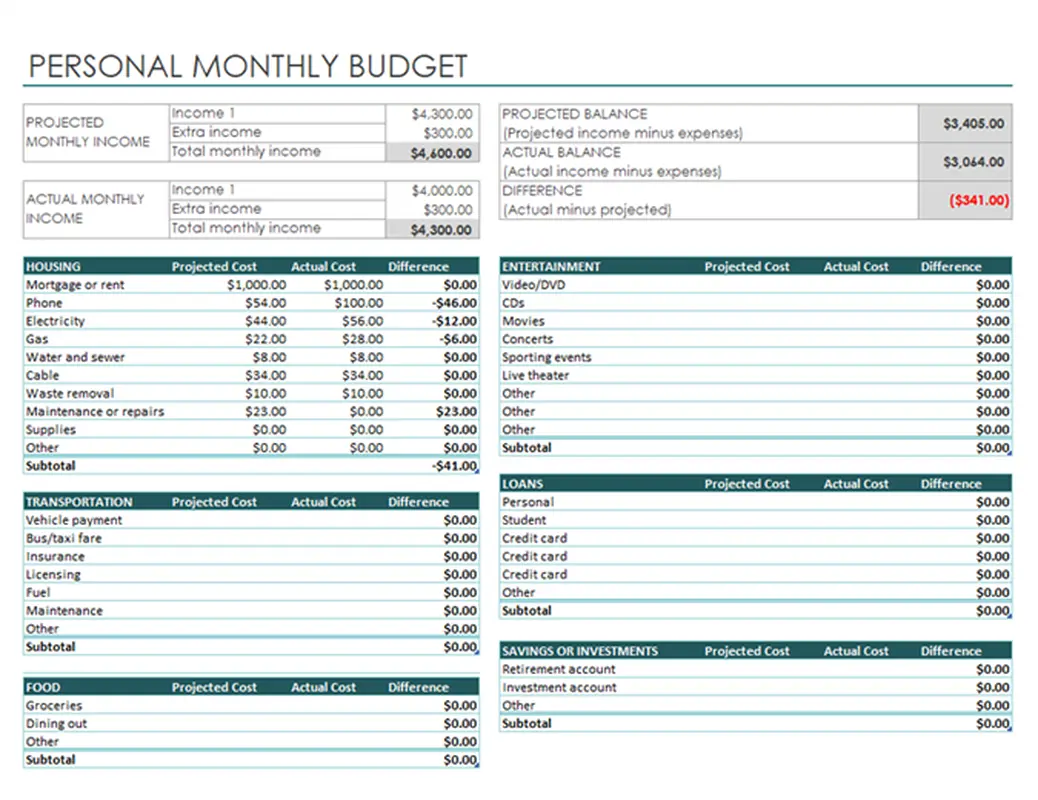 The next step is to make a budget that works for you and your lifestyle. This will help you understand where your money is going and enable you to make necessary adjustments to your spending and saving habits. This step is difficult but essential. For example, how much you spend on clothing is a variable expense, every month it changes. But it is also an optional and necessary expense. What I mean by that is you need shoes, but you may not need those shoes or need them today. You may want them but you don’t need them. Being honest with yourself about these things will be essential.
I was surprised to find how out much I was spending on coffee. It doesn’t seem like much, a six dollar latte, while at work. I deserve it right? I’m working hard. But when you add it all up over a year it’s almost $1500! By seeing it in the number I’m able to be more conscious of how I spend my money. I would rather save up for a few years and get a new bike or go on a trip than drink a latte.
Here are sample budgets in Excel that you download from Microsoft.
Debt Elimination Strategy
First priority is if you have any outstanding debts, prioritize paying them off as quickly as possible. This will not only improve your credit score but also help you save money on interest payments in the long run. It also removes the mental burden that comes with debt. Start with high interest debt. Credit card debt, payday loans and similar. Then work at the car debt and finally the mortgage debt.
• High-interest debt first: Prioritize credit cards, payday loans, and similar high-cost borrowing
• Secured debt second: Address automobile loans and similar secured obligations
• Mortgage debt: Handle real estate debt last, as it typically carries the lowest interest rates
You have heard of “good debt” and “bad debt”. It’s bullshit. It’s just some is worse than others. All debt represents a financial obligation that limits future flexibility. Becoming debt free puts you in a position of freedom. When you are debt free with no mortgage, no car payments, no credit card payments you enter a position of power. You won’t need to work. You will choose to.
Emergency Money Fund Establishment
Once you have paid off the first set of debts, the high interest ones, start to set aside some money for emergencies, such as unexpected medical expenses or a job loss. Aim to save enough to cover at least three to six months of your living expenses. This is where the budget also handy in figuring out how much money you actually need. Put this money in a separate savings account. You don’t want it to be too easy to access otherwise you may be tempted to use it for things that are not “real” emergencies.
Coming to grips with your cash flow and money in general is one of the first steps to financial freedom and a key factor in happiness. Many of the millionaires in Canada and the US don’t look like “millionaires” they live like ordinary people and well within their means. However, they are free from the stress and worry that comes from being in debt. There is more to this “adulting” stuff I will cover in later posts, but creating a budget is a good start and you may even find it fun, or at least eye-opening.